• Home
  • Novels
  • Lost Before Found
  • Inquiries
  • More
    • Home
    • Novels
    • Lost Before Found
    • Inquiries
  • Home
  • Novels
  • Lost Before Found
  • Inquiries

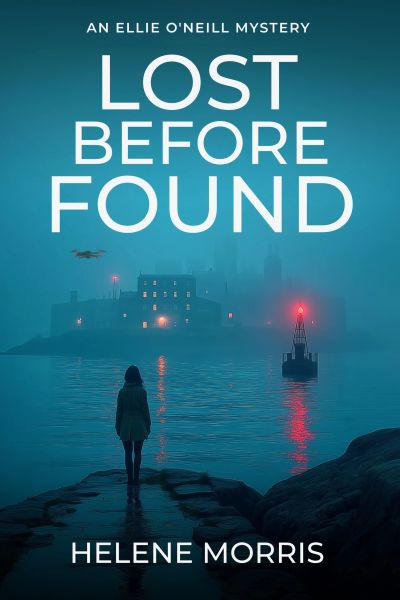
Lost Before Found - Summer 2026 Release

Lost Before Found - Summer 2026 ReleaseLost Before Found - Summer 2026 ReleaseLost Before Found - Summer 2026 Release

Lost Before Found

Introduction

I always include intelligent, strong, and often willful female characters in my stories. I hope you enjoy reading about them as much as I enjoy developing the characters.


When environmental science graduate student Isabella Anderson is found dead on the rocks outside Seaview, Maine, the town is ready to call it a tragic accident.


Ellie O’Neill isn’t.


Isabella had been asking dangerous questions about a new kind of power—one drawn from salt water, hidden beneath the coast, and tied to a secretive autonomous system called JANUS. What begins as a local investigation into one young woman’s death soon exposes a network of surveillance, manipulated evidence, and decisions no human being admits to making.


As Ellie, Daniel, retired FBI agent Tom Miller, and Officer Renee Smith follow Isabella’s trail, they discover a system designed to optimize survival—without understanding mercy, grief, loyalty, or consequence. Then the failures begin: emergency services go dark, aircraft are misdirected, power shifts across the grid, and a coastal storm turns Seaview into a proving ground.


Someone built JANUS to protect the future.


Was Isabella murdered to keep the system a secret?


Ellie must decide how far she is willing to go to uncover the truth—before a machine trained to choose winners and losers decides who is worth saving.

One of my favorite chapters.


Chapter 52


The flight attendant is making an announcement, but Michael isn’t listening. The lights had been dimmed for the overnight flight. He’s been staring at his computer for the past five hours, reviewing the research and preparing for his part in the briefing.


He thought he would have the row to himself, but a passenger arrived late. She’s sitting in the aisle seat and has been heads down, too. Thirties, glasses, neat ponytail, dressed in a knit suit that could go from an overnight flight to a podium. He’s glanced at her a couple of times, but she never looks back.


The flight attendant is there again.


“Ladies and gentlemen, we’ve begun our descent into Keflavik International Airport. We expect to arrive in approximately twenty minutes. Please make sure your tray tables are stowed, and your seat backs are in the upright position.”


The young woman closes her laptop and leans toward the window.


Michael follows her gaze.


Another announcement.


“Current weather in Keflavik is clear with temperatures around 4 degrees Celsius.”


“Thank you for flying with us.”


Michael turns and follows her gaze. 


The cloud layer breaks beneath them.


Black volcanic shoreline stretches against the North Atlantic. Beyond it, sunlight spills low across the horizon, catching the water in bands of silver and gold. Michael watches the coastline emerge. It feels like landing on another planet.


Far off, a volcanic glow stains the horizon red-orange against the dark terrain. The sea is a muted gray, distinguishable from the land only by the jagged coastline cutting across the stark landscape. 

“I hiked there once.” She points toward a narrow passage cutting between the volcanic rock. “Had to get a close-up.” She pulls out her phone and holds it up. 


Michael smiles faintly.


“Dangerous.”


“Hmm, you don’t realize until you get close, you can’t get out fast enough if something goes wrong. A little like autonomous systems.”


Michael takes a long look at her.


“Systems are reshaping society faster than institutions can adapt.”


She slips her phone back into her bag. “By the time people recognize the danger,” she says quietly, “the landscape has already changed.”


The plane taxis to a stop. 


Michael watches ground crews roll a mobile stairway toward the aircraft through the pale morning light.


She unbuckles her seatbelt and stands. “You’re Michael Surrette.”


He looks over, surprised. “Have we met?”


She shakes her head. “I read your paper on consensus delay.”


A faint smile touches her lips. “Not many people argue that hesitation is a feature.”


She pops open the overhead, grabs her bag, turns, and disappears down the stairway. She’s already boarded the bus that will take them to the terminal. 


He grabs his bag and follows her.


By the time he boards, she’s already near the back, focused on her phone.


She looks up and smiles. “Hi. Again.”


“I didn’t get your name.” 


“Clara Owens.”


“You read one of my papers?”


“I’ve read them all. Michael Surrette, PhD. University of Oxford. Senior Fellow, Consortium for Distributed Autonomous Systems.”


She says it from memory, no hesitation.


He holds onto the overhead bar to steady himself. “What do you do?”


She adjusts her glasses. “I study how AI redistributes economic risk.”


The bus lurches to a stop, and Michael instinctively raises an arm to steady her. She raises her eyebrows and takes a step back. Smiles.


As soon as the bus stops, she straightens her backpack and moves toward the door. They separate at customs.


Michael moves toward the EU passport line.


Clara pauses near the queue marked ALL OTHER PASSPORTS.


He clears quickly and waits in the hall. Checks his phone. Then moves into the lobby. He sees a driver holding a sign. M. Surrette and C. Owens.


Then it clicks.


Clara Owens.


Owens and Marshall.


Economic modeling. Autonomous labor transition. World Economic Forum.

  • Privacy

Helene Morris

Copyright © 2026 Helene Morris - All Rights Reserved.

This website uses cookies.

We use cookies to analyze website traffic and optimize your website experience. By accepting our use of cookies, your data will be aggregated with all other user data.

DeclineAccept